Last Updated: October 23, 2026
Quick Summary
To verify sustainable alcohol, check any certification logo by identifying the issuing body, searching the certifier's public directory for the producer's name and certificate number, confirming the certificate's scope and validity dates, and asking what the certificate actually covers. Match the certificate type to the claim: organic certification verifies farming practices, environmental management systems confirm a facility has formal processes, and carbon footprint verification checks measured emissions.
- Run a four-point certificate check: identify the issuing body, find it in the certifier's public directory, check the scope of what was certified, and verify the certificate has not expired.
- When comparing sustainability numbers between products, verify they use the same unit, boundary (cradle-to-gate or cradle-to-grave), allocation method, and reporting year.
- Ask producers directly about water consumption per litre of spirit, energy sources and carbon footprint per bottle, and whether sustainability has been independently audited.
Table of Contents
- Why Verifying Sustainable Alcohol Production Matters
- Understanding Sustainable Spirits Certification Standards
- How to Check Sustainability Claims on Labels
- Key Eco-Friendly Distillery Practices to Investigate
- Reading Sustainable Alcohol Labels: What to Look For
- Questions to Ask a Distillery About Sustainability
- Building Your Verification Checklist
- Frequently Asked Questions
Why Verifying Sustainable Alcohol Production Matters
Many producers use "sustainable" loosely. Learning how to verify sustainable alcohol production protects your wallet and values: you avoid greenwashing, support producers who genuinely minimize their footprint, and decide on facts rather than marketing copy.
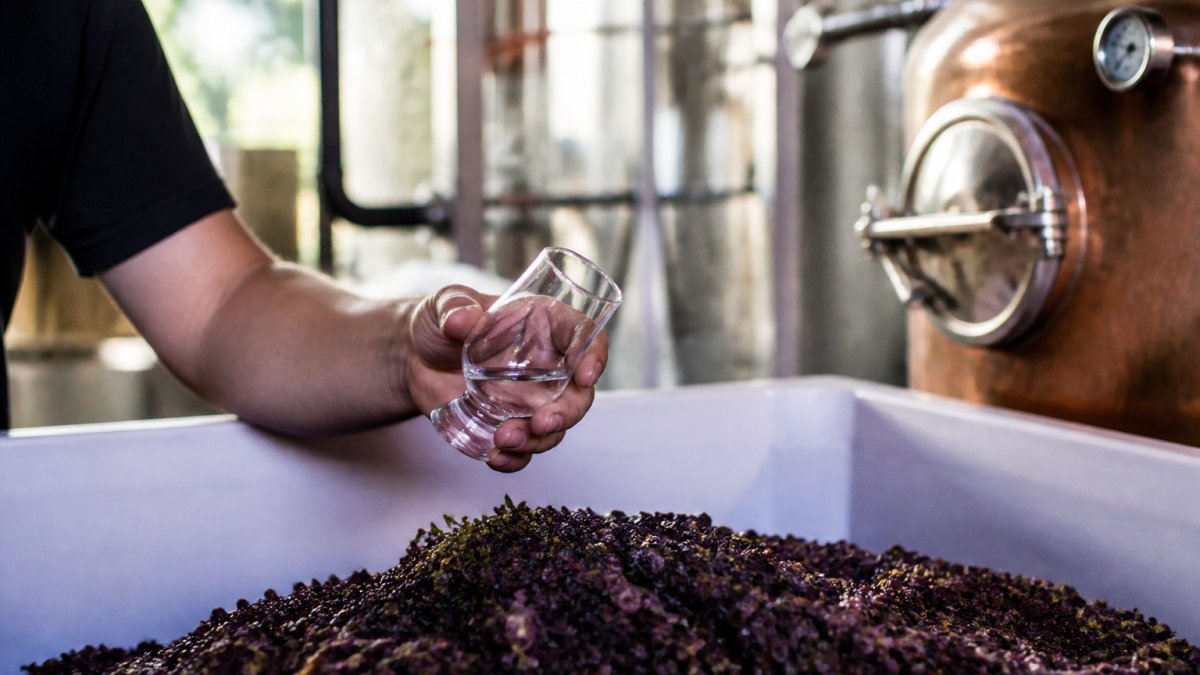
At Three Little Birds Distillery, we've built our operation around transparent, verifiable sustainability practices, starting with sourcing: we transform leftover wine grapes into our base spirit. This guide gives you tools to assess any producer's claims independently, whatever spirit you're shopping for.
Understanding Sustainable Spirits Certification Standards
A third-party certification means an independent body has audited a producer's claims against a published standard. A logo tells you little until you check four things: who issued it, what it covers, whether it is still valid, and whether the product or facility is inside its scope.
The four-point certificate check
Use this sequence for any certification you encounter, on any bottle.
1. Identify the issuing body, not just the logo. A green leaf or tick mark is not a certification.
2. Find the certifier's public directory. Reputable certifiers maintain a searchable list of certified operators, products, or facilities.
**3.
4. Check validity dates and surveillance audits. Certificates have issue and expiry dates, and most schemes require periodic surveillance audits.
What the main scheme types actually measure
Schemes differ in what they audit, which determines what a logo can tell you.
- Organic certification (for example, under the National Standard for Organic and Bio-dynamic Produce) focuses on farming and input rules: prohibited synthetic pesticides and fertilisers, separation, traceability, and handling through processing. It says little about energy use or packaging.
- Environmental management system certification (such as ISO 14001) verifies a facility has a formal environmental policy, identifies significant impacts, sets objectives, and is audited on its management system. It confirms a process exists; it sets no performance threshold.
- Whole-business impact assessments (such as B Corp Certification) score a company across governance, workers, community, environment, and customers. They are company-level, so a high score does not guarantee a specific bottle used low-impact inputs.
No scheme is inherently better; they answer different questions. Match the certificate to the claim. If a label says "sustainably farmed", an organic certificate is relevant evidence. If it says "carbon neutral", an environmental management certificate is not.
Independent audits without a consumer-facing logo
Some producers commission environmental audits outside consumer certification schemes. These can be useful evidence but are harder to verify without a public directory. Ask for the audit date and boundary reviewed, the auditor's credentials and independence, specific findings with measured data, and whether the report was a one-off or recurring. A producer that publishes an audit summary, names the auditor, and states the boundary gives you something checkable; one that says only that it has "been audited" does not.
A certification logo is a claim about a defined scope, not a guarantee about the whole product. Always ask what the certificate covers before you let it settle the question.
How to Check Sustainability Claims on Labels
Labels compress sustainability claims into a sentence written to sound better than the evidence behind it. The practical skill is sorting claims by the evidence they imply and knowing which ones you can actually check.
Sort the claim before you judge it
Tier 1, Certified and scoped. The claim names a certification, an issuing body, and usually a certificate number.
Tier 2, Measured and disclosed. The claim gives a number and a boundary, even without third-party certification.
Tier 3, Process described, outcome unmeasured. The claim describes a practice without a result.
Tier 4, Vague or aspirational. "Eco-friendly", "natural", "working towards sustainability", "planet-positive". Nothing to check.
Evidence-quality red flags
Some patterns reliably indicate a claim will not survive scrutiny:
- A logo with no issuing body or certificate number. You cannot verify what you cannot name.
- "Carbon neutral" with no stated boundary. Neutrality depends on what was counted and offset; without a boundary and offset source, it is unverifiable.
- "More sustainable than conventional" with no comparator. More sustainable than what, measured how, over what boundary?
Comparing numbers without being misled
Once you reach Tier 2, the next trap is comparing figures measured on different boundaries.
Before comparing products, check that the figures share:
- the same unit, for example, grams of CO2-equivalent per litre of pure alcohol, or per 750 mL bottle
- the same boundary, cradle-to-gate (production up to the factory gate) versus cradle-to-grave (including distribution, retail, and disposal)
- the same allocation method, how impacts are split between co-products, which matters for distilleries that also sell spent grain or mash
A common pattern is a cradle-to-gate figure presented as a full life-cycle figure. The number is not false; the comparison is.
The same discipline applies to water. "Litres of water per litre of spirit" can mean process water only, or it can include water used to grow the grain or grapes, very different numbers, and only the second is comparable across products.
A repeatable label check in under five minutes
- Read the back label and write down every sustainability claim, one per line.
- Assign each claim a tier from 1 to 4.
- For every Tier 1 claim, run the four-point certificate check (issuing body, directory, scope, validity).
- For every Tier 2 claim, look for a methodology note stating unit and boundary.
- For Tier 3 and Tier 4 claims, note what evidence would move the claim up a tier, and ask the producer.
- Compare products only on Tier 1 and Tier 2 claims that share a unit and boundary.
This works across beer, wine, and spirits because it depends only on whether the claim gives you something checkable.
Key Eco-Friendly Distillery Practices to Investigate
Water use and conservation methods
Distilleries consume significant water; sustainable operations measure and reduce it. Look for producers who disclose:
- Water consumption per litre of spirit produced (lower is better)
- Water treatment and recycling systems (how wastewater is handled)
- Source transparency (where water comes from)
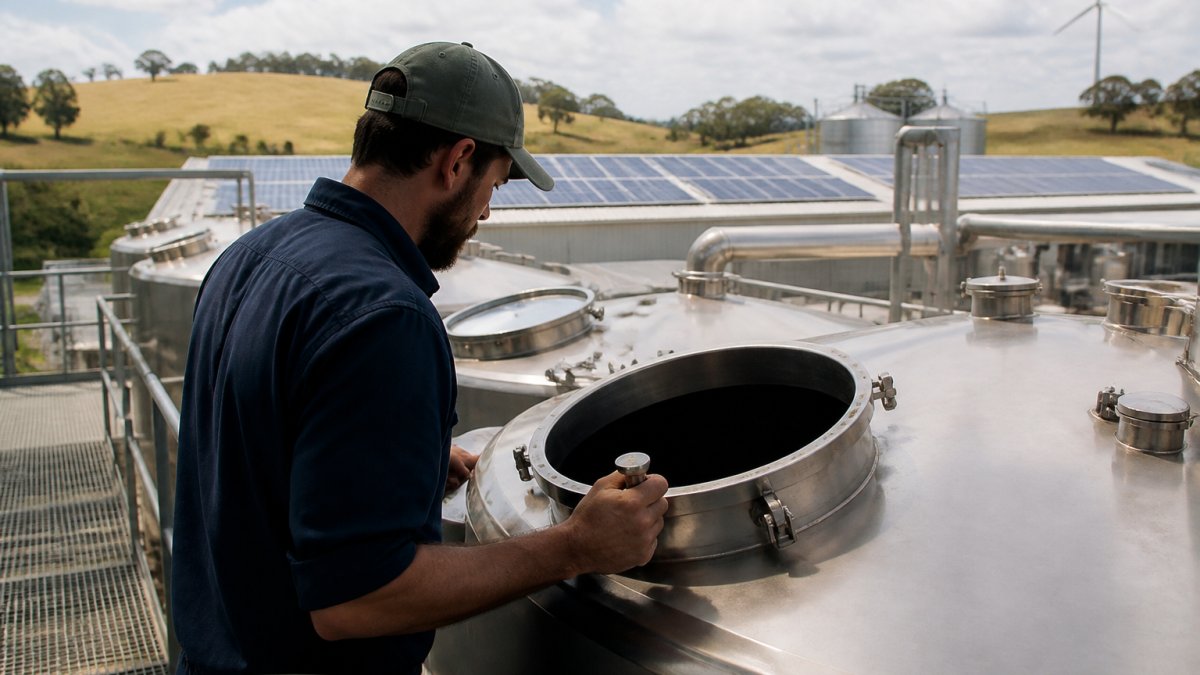
Some recirculate cooling water, harvest rainwater, or treat wastewater for reuse. Ask directly: "What's your water consumption per litre of spirit? How do you treat wastewater?" Producers with solid practices answer specifically.
Energy sources and carbon reduction
How a distillery powers production substantially determines its carbon footprint. Sustainable operations use:
- Renewable energy sources: Solar panels, wind power, or biomass boilers
- Energy-efficient equipment: Modern stills and cooling systems consume less power
- Waste heat recovery: Capturing heat from fermentation or distillation for other processes
Check whether a producer has published a carbon footprint assessment showing emissions per bottle and reduction targets. Three Little Birds Distillery integrates renewable energy into production, tracks our carbon footprint annually, and commits to measurable reductions, we're not just talking about sustainability, we're measuring it.
Waste management and resource efficiency
Sustainable distilleries minimise waste at every stage:
- Spent grain or botanical reuse: Leftover solids feed livestock or compost
- Bottle and packaging optimisation: Lighter bottles reduce transport emissions; recycled materials reduce resource extraction
- Kitchen and production waste composting: Organic waste returns to soil rather than landfill
Ask whether the distillery has a formal waste audit tracking what leaves the facility and where it goes. Composting and animal feed partnerships are measurable commitments.
Reading Sustainable Alcohol Labels: What to Look For
Certified claims and certification bodies
A certification logo means an independent body verified specific claims, but logos vary in rigour.
When you see a certification:
- Identify the issuing body (the organisation that issued the certification)
- Check their website for audit details and scope
- Verify the certification date (is it current or expired?)
- Read the specific criteria (what exactly was audited?)
Legitimate certifications display this information openly. If you can't find audit details online, the certification may not be credible.
For example, organic certifications in Australia are regulated by NASAA (National Association for Sustainable Agriculture, Australia) or ACO (Australian Certified Organic). Both publish detailed standards and auditor lists.
Packaging and recycling information
Packaging accounts for a significant portion of a spirit's environmental footprint. Look for labels that specify:
- Bottle weight and material composition (e.g., "420g recycled glass, 30% post-consumer content")
- Recyclability information (whether bottle, cap, and label are recyclable in your area)
- Refill or return programmes (some distilleries offer bottle returns for reuse)
Lighter bottles reduce transport emissions, and recycled glass saves energy compared to virgin glass. These details should be disclosed.
Questions to Ask a Distillery About Sustainability
Supply chain and ingredient sourcing
Understanding where ingredients come from reveals whether sustainability extends beyond the distillery gates. Ask:
- Where do your botanicals or grains come from? (Named suppliers, specific regions)
- Do you work with certified organic growers? (Verification of farming practices)
- How do you verify your suppliers' environmental practices? (Audits, certifications, partnerships)
Three Little Birds Distillery sources native Australian botanicals locally. We know our suppliers personally and verify their practices. This traceability is part of genuine sustainability.
For spirits using grains or other bulk ingredients, ask whether suppliers are certified organic or follow specific environmental standards. Sustainable alcohol production starts with sustainable sourcing.
Production methods and environmental commitments
Ask about the actual processes used in production:
- What energy sources power your distillery? (Renewable percentages, specific sources)
- How do you handle wastewater and byproducts? (Treatment methods, reuse programmes)
- What's your carbon footprint per bottle? (Measured and tracked)
Producers with solid practices answer these questions directly. They have data. They've measured impact. They're comfortable sharing details because they back their claims.
Vague answers like "We're working on sustainability" or "We try to be environmentally responsible" indicate the work hasn't been formalised or measured.
Building Your Verification Checklist
Use this checklist when evaluating any sustainable alcohol brand:
Certification and Auditing:
- Does the label display a third-party certification logo?
- Can you identify the certifying body and verify it's legitimate?
- Is the certification current (not expired)?
Transparency and Specificity:
- Does the label include specific, measurable claims (not vague language)?
- Can you find detailed sustainability information on the producer's website?
- Are carbon footprint or water consumption figures disclosed?
Supply Chain:
- Are ingredient sources named or described?
- Does the producer verify suppliers' environmental practices?
- Is there evidence of long-term supplier relationships?
Production Practices:
- Does the producer use renewable energy? (Percentage disclosed?)
- Are waste management practices described?
- Is water consumption tracked and disclosed?
Packaging:
- Is bottle material and weight specified?
- Does the label indicate recyclability?
- Is recycled content percentage disclosed?
Red Flag Check:
- Does the label use vague terms like "eco-friendly" without specifics?
- Are environmental claims made without verifiable sources?
- Does the producer refuse to share audit or sustainability details?
If a producer ticks most boxes in the first four sections and none in the red flag section, you can trust their sustainability claims more confidently.
Verifying sustainable alcohol production takes a few minutes but protects your values and your money. You avoid brands that greenwash. You support producers genuinely committed to environmental responsibility.
At Three Little Birds Distillery, we've built sustainability into every step: from sourcing leftover wine grapes as our base spirit to composting kitchen scraps for the vineyard and repurposing spent botanicals to feed local livestock. But we don't ask you to take that on faith. Our practices are measurable, auditable, and transparent. When you choose a spirit, ask the same questions.
NASAA organic certification standards and Australian Certified Organic requirements provide detailed criteria for verifying organic claims on spirits. For broader environmental standards, ISO 14001 environmental management guidance outlines formal auditing frameworks many distilleries adopt.
Frequently Asked Questions
What does 'certified sustainable' actually mean for spirits?
Certified sustainable means an independent third party has audited the producer's environmental practices against specific standards. Look for certifications from recognised bodies that verify claims about water use, energy sources, waste management, and supply chain practices. Certification requires ongoing compliance and regular audits, not just a one-time assessment. Without third-party verification, 'sustainable' is marketing language only.
How can I verify a distillery's sustainability claims are credible?
Request specific evidence: ask for certification documents, audit reports, and measurable metrics (e.g., litres of water per litre of spirit, renewable energy percentage, waste diversion rate). Check if the distillery publishes a sustainability report or environmental policy. Visit their website for supply chain transparency. Credible producers welcome scrutiny and provide detailed answers; vague responses or refusals to share data are red flags.
What should I look for on a sustainable alcohol label?
Look for the name of a recognised certification body (not just a generic 'eco-friendly' claim), details about organic or biodynamic farming if applicable, information about packaging recyclability, and sourcing transparency. Legitimate labels include a certification number or QR code you can verify independently. Avoid labels with only adjectives like 'natural' or 'green' without supporting credentials or specific practices listed.
Are locally sourced botanicals more sustainable than imported ones?
Local sourcing typically reduces transportation emissions and supports regional ecosystems, but sustainability depends on farming practices too. A locally grown ingredient using heavy pesticides may have a larger environmental footprint than an imported organic alternative. Verify both the sourcing location and the farming method (organic certification, chemical management practices) rather than assuming local automatically means sustainable.
